“The Way” to God

In our final week of class, we had the opportunity to watch The Way, a movie in which the protagonist, Tom, loses his adult son, Daniel. At the time of his death, Daniel had just began the “Camino de Santiago,” a traditional journey from the Pyrenees in France to the shrine of St. James the Apostle in Galicia, Spain. Unfortunately, Daniel died in a violent storm on his first day of walking. In response, the mourning Tom decides to walk the Camino in his son’s place, spreading Daniel’s ashes along the way. During his travels, he runs into three other “peregrinos” (pilgrims): Jost, Sarah, and Jack. Each pilgrim has their own reason for the journey: to lose weight, to escape a violent lover, or to write a book, respectively.

Related to this movie, we read an excerpt from The Jesuit Guide to (Almost) Everything: A Spirituality for Real Life by Father Jim Martin. In his book, Martin discusses the various paths that people may be on in their spirituality with God. These paths include: belief, independence, disbelief, return, exploration, and confusion. He also notes that a person may be on more than one path at once. As the word “camino” means “path” or “way,” in Spanish, it is only natural for us to apply Martin’s concepts to the characters in this movie!

For the sake of this blog post, let’s focus on Tom, our protagonist. He’s an older man, probably in his early seventies, and works as an ophthalmologist. At the beginning of the movie, we see Tom’s interactions with his secretary as well as his golf buddies. Although he has a successful career and enough money to live the country club lifestyle, Tom is visibly unsatisfied and even withdrawn. We can deduce that the source of his poor outlook is his strained relationship with his son.

According to Tom, he has not gotten along with Daniel since his wife died. Their most recent dispute occurred when Daniel said he would stop pursuing his doctorate and travel the world instead. In response, Tom was in firm disapproval and argued all the way to the airport. Unfortunately, that would be the last time he would ever see Daniel alive.

At that point in the movie, it is impossible for us to know Tom’s religious beliefs. However, when he gets news of Daniel’s death, Tom is seen sitting in a church, accompanied by a priest. The priest asks him if he would like to pray together, and Tom responds with, “What for?”

Based on that response, I would diagnose Tom on the path of confusion. According to Martin, someone on the path of confusion “runs hot and cold with their childhood faith, finding it relatively easy to believe in God at times, almost impossible at others.” Martin also notes that one in a confused state “may pray from time to time, particularly when in dire need, and they may go to services on key holidays.” In my opinion, Tom closely conforms to that description. On one hand, he apparently did make the effort to mourn at a church. On the other hand, he did not want to pray to God, because he doubted it would make a difference. This situation goes under the category of finding it “almost impossible” to believe at times. Tom also admits at another point in the movie, (while talking to a different priest), that he doesn’t really practice his faith, and he only goes to mass on Christmas and Easter. Regardless, the priest gives him rosary beads to use.

As mentioned by Martin, it is possible for one to walk on multiple paths at once. In my opinion, that concept accurately applies to Tom during the Camino. For instance, at the beginning of the journey, he encounters a crucifix in the ground, makes the sign of the cross, and spreads his sons ashes at the site. It is possible that Tom had this sudden spiritual inspiration because he saw a vision of Daniel near the crucifix. Indeed, a sign from God can help restore one’s faith. Regardless of the reason, Tom repeats this practice throughout the movie – finding various places to spread Daniel’s ashes, and generally making the sign of the cross before doing so. In addition, Tom later admits to praying the rosary during the Camino, which he says has helped him. Overall, these situations show that Tom is on a path of return to God. During the trip, he becomes more religious than he had been in years. He went from someone who barely went to Church, to someone who prays daily. However, Tom is simultaneously on a path of confusion, as conveyed by his drunken outburst and other negative moments.

During the course of the movie, we also see a visible transformation in Tom’s overall attitude. While he initially acts quite distant and is unkind to his trail-mates (because he is in mourning), Tom gradually opens up to them and becomes a sort of father figure for the group. It is possible that Tom’s regained spirituality improved his mood, or maybe it was the opportunity to become a father again. By the end of the movie, I believe we can consider Tom still on the path of return, or maybe on the path of belief. As with anything in spirituality, it is hard to define for certain since we do not know his thoughts.

All in all, The Way is a touching movie, and allowed for us to see some of the six “paths” to God in action. Tom, in particular, showcased the paths of confusion (and maybe even a mild disbelief) at the start of the movie, yet began on a path of return or belief by the end of the movie. It is apparent that the Camino is powerful and can aid in spiritual reflection!
Ignatian Spirituality: Paths to God Playlist

This week, we learned about St. Ignatius of Loyola, the founder of the Society of Jesus (the Jesuits), and his unique outlook on spirituality. Commonly referred to as the Ignatian Spirituality, it stresses a personal relationship with God that goes beyond religious practices. According to The Jesuit Guide to (Almost) Everything: A Spirituality for Real Life by James Martin S.J, Ignatian Spirituality consists of four main tenets: finding God in all things, becoming a contemplative in action, looking at the world in an incarnational way, and seeking freedom and detachment.

Martin also introduces the six “paths” which people may find themselves on in their relationship with God and religion. These paths include belief, independence, exploration, confusion, disbelief, and return. Martin notes that we often change paths as we grow older and progress past childhood religious beliefs. He says that no single path is foolproof – each can have positive and negative realities depending on the individual. In addition, it is possible to be on more than one path at a time. At the moment, I’d say I’m on the confused path – I believe strongly in God at times, yet I lose faith during times of tragedy and inexplicable phenomena. I also sometimes get bored with religious observances (such as going to Mass).

For this blog, I’ve chosen 6 “theme songs” which I believe represent the six paths to God:

Belief’s Theme Song: “All I Need is You” by Lecrae

This song, performed by the Christian rapper Lecrae, is a perfect example of the path of belief. Someone on this path has a strong faith that God is with them at all times, and in all aspects of life. This person is dedicated to their spirituality, and strives to live a holy life with God’s help. A key lyric that connects this song to the path of belief is:

“You ain’t gotta question my allegiance, cause the way you love me I could never leave ya, I need ya.”

Independence’s Theme Song: Forget You by Cee Lo Green

Someone who is on the path of independence has become disenchanted with their given religion, yet still believes in God. I can imagine this song playing as the independent believer leaves their church for the last time. Most likely, this person is tired of their religion for one reason or another, and will try various other ones. Maybe the church focuses too much on finance or politics? Maybe it has a history of clergy abuse? Instead of joining another religion, the independent individual may also opt to be “spiritual” on their own, without an established religion. Besides the song’s title, here are some applicable lyrics from this song:

But the way you play your game ain’t fair.
I pity the fool that falls in love with you ohh.
(Oh ‘shh, she’s a gold digger)
Well.
(Just thought you should know)
Ooooooh

Exploration’s Theme Song: “Candle in the Wind” by Elton John

This song, from Elton John’s 1973 album Goodbye Yellow Brick Road, has lyrics and imagery which relate to the path of exploration. As noted by Martin, a person on the exploration path may believe in God, but is still establishing which religion best fits their beliefs about God. As such, this explorer may bounce from religion to religion. Martin says that this process can be positive if they find the right fit, but it can be depressing if the individual is never content and ends up without a steady religious community. The chorus of this song relates to the idea of constant movement:

“And it seems to me you lived your life, like a candle in the wind. Never knowing who to cling to, when the rain set in.”

Confusion’s Theme Song: “Where Are Ü Now” by Skrillex, Diplo, and Justin Bieber

When someone is on the path of confusion, they don’t know what to make of God anymore. They may believe in Him during good times, yet doubt him during tough times…Or maybe its the other way around. When something goes awry in their family life or the world is struck by a deadly coronavirus, they may even question God’s existence. In desperation, they may shout to the heavens and ask God where he is! That’s why this song is a suitable fit for the path of confusion – especially in the following lyrics:

“Where are you now that I need ya? Couldn’t find you anywhere…”

“I gave you attention when nobody else was payin’. I gave you the shirt off my back, what you sayin,’ to keep you warm. I showed you the game everybody else was playin’, that’s for sure. And I was on my knees when nobody else was prayin’, oh Lord…”

Disbelief’s Theme Song: “El Chapo” by The Game and Skrillex

According to Martin, people on the path of disbelief have concluded that God does not exist, generally on the basis of deep theological research. While this song is not deep or theological by any means, it repeats the phrase “I am the God!” many times, which reminds me that an atheist essentially acts as their own god. By denying that God exists, they have decided to lead their own life completely. (Of course, this song is actually referencing the drug lord “El Chapo” and not the Lord, but you get the point).

Return’s Theme Song: “Feeling Good” by Nina Simone

This beautiful song, which unfortunately plays in too many car commercials, reminds me of the path of return. Someone on this path is returning to their religion and coming to new terms with their faith. According to Martin, many people on this path were believers as children, but lost their faith over time. I believe that the following lyrics represent how someone with a refreshed and enlivened faith would feel:

“It’s a new dawn, it’s a new day, it’s a new life for me, ooh, and I’m feeling good.”

Christology: The Importance of the Cross

In this week’s readings, we dove further into Christology’s key question: “Who do you say that I am?” This time around, we focused on the perspectives of the late James H. Cone, the father of black liberation theology, as well as Roberto S. Goizueta, a Cuban-American theologian. In their essays (Cone’s Strange Fruit: The Cross and the Lynching Tree and Goizueta’s From Calvary to Galilee), the theologians express similar beliefs about Christ and the significance of His crucifixion. Both men, representing minorities in Christian theology, argue that Christ’s death on the cross has a powerful, liberating message for all people – particularly the outcasted, poor, and minorities. In addition, His death offers liberation for oppressors if they are willing to repent.

Unfortunately, most Christian Americans do not recognize this authentic message, according to Cone. Instead, they regard the crucifixion with a watered-down “theory of atonement.” He describes this theory in the following words:

“Many orthodox and evangelical Christians believe that Jesus died on the cross to redeem humanity from sin. They say Jesus took our place and suffered on the cross for us so that we will not forever burn in hell… We are now, Paul said, “justified by God’s grace as a gift, through the redemption that is in Christ Jesus, whom God put forth as a sacrifice of atonement by his blood…(Rom 3:24-25)”

According to Cone, Christians who believe strictly in atonement are taking a shortcut in their faith. Instead of acknowledging the harsh realities of Jesus’s crucifixion, they choose to ignore them. He notes that even “the cross has been transformed into a harmless, non-offensive religious object that Christians wear around their necks as a sacred fashion piece and place on Church steeples and altars to decorate their sanctuaries with a symbol of holiness.” In other words, Christians glance over the suffering that Jesus endured, as well as the true purpose of that suffering.

According to Goizueta, we try to forget Jesus’s suffering (and the role which humans played in it), because we are scared of our own death. He says that in general, “we distance ourselves from weak, powerless, vulnerable persons in particular—wounded persons…so that we won’t have to see them and their uncomfortable wounds.”

As a black theologian, Cone applies this concept to the uncomfortable wounds left by lynching in America’s past. He notes that, instead of having open conversations about lynching and attempting to make amends, many whites prefer to act like it never happened. Throughout his essay, Cone compares the lynching of black Americans (and modern society’s attitude toward it) to the crucifixion of Jesus Christ.

He asserts that:

“Unless the cross and the lynching tree are seen together, there can be no genuine understanding of Christian identity in America and no healing of the racial divide in churches and seminaries as well as in the society as a whole. I know the cross and the lynching tree are not comfortable subjects to talk about together. Who wants to think about lynched black bodies in church workshop or when doing a theological reflection on Bonhoffer’s question, “Who is Jesus Christ for us today?” This is exactly what I contend the gospel requires Christians to do…”

In that statement, Cone conveys that we need to make the unpleasant connection of Christ’s crucifixion to the lynching tree because both tragedies are very similar. For instance, in both cases, innocent people were executed publicly by hanging. In addition, the guilty oppressors later tried to downplay the victim’s suffering.

These tragedies are also complementary because they give meaning to each other. As explained by Goizueta, while Christ’s death and resurrection could not “justify the crucifixion, it justifies the crucified victim – the whole victim, abandoned soul and scarred body.” Later on, Goizueta adds that Christ’s resurrection did not simply restore Jesus’s life, but also “his compassionate relationships with the poor, sinners, prostitutes and other “unsavory characters.” If we consider these quotes in the light of lynched black people, we realize that Jesus’s death on the cross restores their relationship with God.

In his essay, Cone notes three powerful relationships that evolve when people relate the cross to the lynching tree. First, if Christians associate the cross with an unpleasant historical phenomena, they will start to realize how vile the crucifixion was. Therefore, when they look at their crucifix, they will recall a crucified Christ and burned black bodies. They will desire to repent, and will not feel self-satisfied and holy.

Secondly, the cross gives lynching victims a meaning for their existence; these people suffered just like Christ and will live with him forever. They are liberated by Christ. In contrast, if Jesus did not die on the cross, their deaths would be for naught. For this reason, Cone says that the cross provides “hope beyond the lynching tree.” The victims didn’t just die – they have an afterlife destination.

Finally, Cone notes that Christ’s death and resurrection offers liberation to all people, including persecutors. Therefore, if racist white people repent and change their ways, they still have hope for eternal life. For this reason, Cone believes that comparing the cross and the lynching tree will help heal racial divides in the church. If Christian Americans begin to admit the wrongdoings of the past, they will be more conscious in the future. This consciousness will spill into all facets of society as well.

I’ll close-up this blog by touching upon one last piece of Cone’s essay. To the surprise of readers, the theologian notably refers to the word of God as offensive. Of course, “offensive” may seems like an interesting word for a theologian to describe God’s word. However, what he really means is that it’s difficult to follow God! It’s not a cake walk. For example, you have to accept harsh realities (such as Jesus’s ugly crucifixion), you have to genuinely repent for your sins, and you have to live in Jesus’s example. Finally, you can’t brush issues like lynching and racism under the rug; you have to be willing to have difficult conversations and aim to be a better person at all times.

A Glance at African Christology: “Who Do You Say That I Am?”

In this week’s materials, we covered the topic of Christology with a special focus on the use of Christology in Africa. In its simplest definition, Christology is the study of Jesus Christ, the Son of God, and the mystery of his Incarnation. Christologists over the millennia have posed countless questions about Jesus and his purpose, including:

How can Jesus be both fully God and fully human?

Why did Jesus need to come to earth and die on the cross?

How did Jesus’s human existence relate to our own human existence?

While Christology has yielded sound answers to these questions through the decisions of Church councils and the studies of theologians, we still must accept that as human beings we will never completely understand the nature of Jesus Christ or the Trinity. For that reason, Christology is a constant search for the answer to the following question which Jesus asked his disciples: “Who do you say that I am?”

The answer to this central question can vary greatly for each group of Christians because Jesus Christ means something different to every culture. This week, we took a look at what Jesus means to Africans from two different perspectives: the perspective of African women, and the perspective of African “Bantu” culture in general.

According to Anne Nasimiyu-Wasike in “Christology and an African Woman’s Experience” Christ is seen by African women as a liberator, comforter, and friend. Jesus takes on these roles in the eyes of the women because of the cruel environment they live in: one where they are underappreciated, overworked, sexually abused, and often objectified. The author explains that in Africa, women tend to work up to 18 hours a day to provide for their husbands and children. In some agricultural nations, they even hold up most of the economy. Regardless, African women are seen as less intelligent, unable to comprehend church teachings, and exist mainly to give birth and take care of their families. Nasimiyu-Wasike notes that the women are essentially made to feel like “second-class disciples in the Church.”

The author also includes direct quotes from several African women about their opinions on Jesus. The common theme among the women is that they believe Jesus is with them at all times and mutually struggling with them. For instance, Jesus works with them in the fields, and He is there to listen to their concerns like a good friend. Jesus also listens to their prayers and passes them on to the Father. Additionally, one woman notes that Jesus is a protector who drives away evil spirits and keeps her family safe.

The author mentions that African women are able to relate to Jesus because he has historically been feminist. Although conventional Judaism shunned women, Jesus invited women into serious theological conversation, shared meals with them, and kept women as disciples. In addition, the women can relate to Jesus through their constant suffering for their society because Jesus suffered for all of humanity. Thus, to the women, Jesus can be seen as the liberator who will free them of their pain and suffering when they die, (since he died on the cross for their sins).

Overall, the ways in which these African women view Christ is a perfect example of the adaptive nature of Christology. I find it interesting how suffering always tends to draw people closer to Jesus. This concept applies to what I have seen in today’s world too. For instance, my mom has more religious in fear of the coronavirus and its impact on the world…When people are uncertain of life and feel afraid or broken down, they often turn to God.

This week we also read about the way that Bantu Christians in Africa view Christ as their “Ancestor” and “Elder Brother.” In the reading by Francois Kabasele, we were introduced to the long history of ancestral worship in Bantu culture and how that reconciles with Christianity.

In Bantu culture, the people who are eldest have always been revered. For instance, the Bantu people worship and make offerings to their Ancestors who were the first to receive life from God because they are the closest human beings to God. These Ancestors have the ability to bring good favor upon the lives of the humans on earth through God. They are essentially intermediaries between God and His people (like Catholic saints except they can’t be saints since they haven’t known Jesus). Among the living Bantus, the eldest brothers in the family receive respect and adoration from the younger brothers.

The main Christological point in this article is that Jesus is seen by Bantu Christians as basically the “Eldest” Ancestor or Brother since he is the closest to God. Jesus is closer to God than any other Bantu Ancestor, and since he took on the human form, He is their Brother too. As such, the Bantus worship Jesus primarily and refer to him as “Jesus Our Ancestor” or “Jesus Our Elder Brother.”

Kabasele notes that although Jesus is their highest priority for worship and sacrifice, they still honor their other Ancestors at mass and incorporate these ancestors into all parts of their daily lives. For instance, they pour a bit of the wine from mass on the ground for their Ancestors to drink, and if they find something funny during the day they share it with their Ancestors. I find this part of the Bantu culture most interesting because they never forget those who came before them, which is unique. We can compare this familial ideal to the 10 Commandments which taught us to “Honor thy father and thy mother.” I find it quite logical to revere those who came before us, because they will always have more wisdom and life experiences than us.

Overall, we see that from a Christological perspective, the Bantus view Jesus as someone who is constantly watching over them in daily life and assisting them by being an intermediary to the Father. Interestingly, this idea is very similar to the Christological perspective of African women that we read about.

I personally enjoy these answers to the question “Who do you say that I am.” I think that these Christological views differ from my own view since I don’t have to undergo as much suffering in my life. The first article mentions how the African women consider Jesus to be involved in all the minutia of their lives. Every second of every day, Jesus is with them. The author notes the contrast of their belief in Jesus to the beliefs of those who reserve their religion for specific days of the week or specific times of day. I think I fall into the latter category of believers unfortunately. I do view Jesus Christ as the Savior who died for our sins, but at this point I don’t view him as my close friend or brother. In times of pain I do ask him to protect me though, just as the African women do, and I do ask him to be an intermediary for me to God.

All in all, these readings about African Christianity show that although many Christians share fundamental views on who Jesus is, Jesus can mean something different to each person or culture. The answer to the central question of Christology varies based on the surroundings people live in, and the impact of faith on their lives.

A Brief Post on Feminist Theology

I had the opportunity today to listen to a podcast by Dr. Karen Ross which provided a nice overview of feminist theology. In the episode, Ross explains a chapter from Elizabeth Johnson’s book “Quest for the Living God” called “God Acting Womanish.” At the beginning, Ross defines feminist theology as “the study of God and the way people talk about God with the aim of equality and mutuality between the sexes.”

In short, feminist theologians are people who do not conform to the patriarchal practices and teachings of the Church. Instead, they seek to prove those teachings as unfounded by: researching the oppression of women in the Church, promoting little-known biblical passages that honor women, and attempting to re-interpret sexist interpretations of Bible passages called “texts of terror.” Overall, these women fight to prove that women and men are equal in the eyes of God.

In my opinion, their feminist battle is a worthy one. Call me progressive, but I’ve never understood why the Church is sexist and favors men to begin with. For instance, I believe that women should be allowed to be priests if men can be priests. I mean, both sexes were created equally and in God’s image according to the Book of Genesis!

One of the main topics that Ross discusses from Johnson’s book is the use of masculine “God talk” among the Church and its followers, (meaning that people always refer to God with the pronouns He/Him/His). She notes that this type of talk can be highly problematic for a few reasons. First of all, people use masculine God talk exclusively, which insinuates to the world that men are more God-like than women. This attitude then leads to the subordination of women in our patriarchal Church and society. Additionally, people tend to interpret the masculine God talk as reality, causing them to be idolatrous – instead of viewing God as a higher-being of which we cannot grasp, people simplify God with male features, (which often tend to be white). This simplification can be considered idolatry because people who view God in this way are worshiping an image that is not truly God.

I personally agree with Johnson’s argument against the use of masculine God talk. I feel that the most effective part of her argument is the concept that when we consider God to be a man, it allows for the subordination of women. It is only logical for Christians to conclude that men are superior to women if the creator of all things is a man.

Listening to Ross’s podcast on feminist theology was a truly eye-opening experience for me, since it points out how the Church has inherent discrimination against women. I feel that this type of theology should get more attention from Christians because it is important for both sexes to realize the true value of women. I find it especially unfortunate that many religious women buy into the idea of these “texts of terror” and conclude that their husbands should rule over them. Especially the older generation of Catholic women tend to feel this way in my experience. It makes absolutely no sense for women to be less than men if the sexes were created equal, and believers in God should avoid that unjust train of thought.

In my life, I don’t know if I’m likely to change how I refer to God from He to She or to something else. However, I am now more aware of the reality of masculine God talk and will mentally remind myself that God is not actually gendered.

Finally, to close off this post, I’d like to relate Johnson’s ideas of feminist theology to Sojourner Truth’s 1851 speech “Ain’t I a Woman.”

In Sojourner’s speech, she makes note that she is just as strong as any man, can do just as much work as any man, and would eat just as much as any man if it were available to her. She also directly addresses a man in the room who stated, “women can’t have as much rights as men because Christ wasn’t a woman.”

In response to the man, she notes that Jesus Christ, our Lord and Savior, came from God and a woman. Men did not contribute whatsoever in the process.

Lastly, she says that if Eve could turn the whole world upside down, today’s women could flip it right side up again.

Sojourner’s words relate to the idea of feminist theology (and feminism as a whole) because she proves why men and women are inherently equal. By asserting that she has the same work ethic and hunger as a man, she represents the equality of the sexes. In addition, referencing Mary’s role in the birth and mission of Jesus Christ demonstrates the importance of women in the world. Finally, Sojourner references the story of Adam and Eve to correct a negative stereotype against women that stems from that story. As noted in Ross’s podcast, early Church father Tertullian asserted that Eve, who symbolizes all women, was the cause of all human sinfulness. In Sojourner’s speech, she flips that narrative by using Eve as an example of women’s strength and their willingness to do right.

Overall, both Dr. Ross’s podcast on feminist theology and Sojourner Truth’s classic speech highlight the need for feminism in both the Church and the world, and discuss the women who are currently working to achieve it.

How Do You Explain “The Trinity”?

In Catholicism, the concept of the Trinity is of utmost importance. As monotheists, Catholics believe that there is only one true God. However, that singular God is made up of three divine persons: the Father, the Son, and the Holy Spirit. Catholics also believe that the Son, (Jesus Christ), is fully God and fully human. He is believed to be “consubstantial” (meaning “of the same substance”) with the Father.

Although it is simple to recite these beliefs during the Nicene Creed at mass, if you actually take time to reflect on the idea of three persons in one God, it gets confusing. How could this phenomenon ever occur? In reality, it’s impossible for humans to explain. While we’ll never be able to completely comprehend the Trinitarian concept during this life, art is one way we can attempt to understand it!

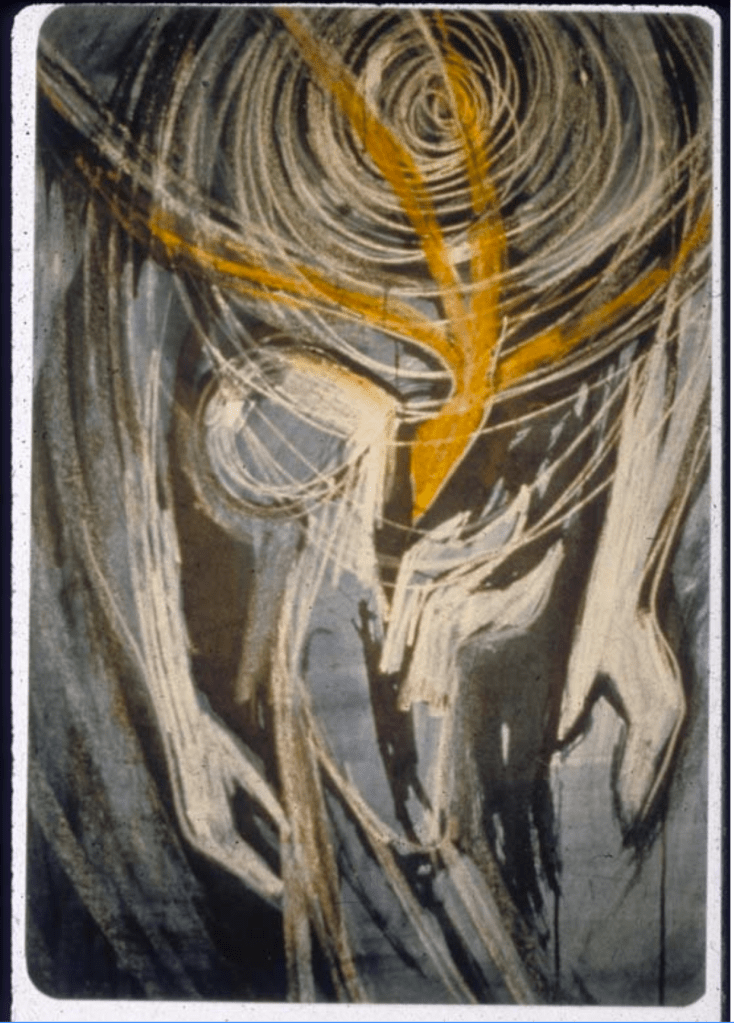
Below is one abstract example of Trinitarian art. It is called Blessed Trinity and was created by Marlene Scholz in the late twentieth century:

Blessed Trinity is one of my favorite depictions of the Trinity because through its use of line and color scheme, it shows how the three persons make up a single God. For instance, the swirling lines in the image create a sense of continual movement, which coincides with the Trinitarian belief of Perichorisis (the concept that the three divine persons are interwoven and are constantly moving or dancing around each other).

The circular swirl at the top of the image serves as a depiction of Heaven. From that heavenly swirl, we see that the hands of the Father deliver the Son to live on the Earth. The Son is shown on his knees praying to His Father in heaven – a common practice for Jesus, as recorded in the New Testament. We also see the Holy Spirit descending from Heaven, (in the form of an orange dove), which allowed Jesus to become incarnate through Mary.

One interesting nuance of this picture is that both God the Father and the Son are drawn in the same color: white. This homogeneous color code helps explain that these two members of the Trinity are consubstantial, or, of the same substance with each other. Meanwhile, the Spirit is depicted as a fiery orange dove, appearing to fly into Jesus and become a part of Him.

Both the dove and “tongues of fire” were common biblical symbols for the Holy Spirit. A prime example is the Baptism of Jesus: “and the holy Spirit descended upon him in bodily form like a dove. And a voice came from heaven, “You are my beloved Son; with you I am well pleased (Luke 3:22 NAB).”

Another example is the Pentecost: “And suddenly there came from heaven a noise like a violent rushing wind, and it filled the whole house where they were sitting. And there appeared to them tongues as of fire distributing themselves, and they rested on each one of them. And they were all filled with the Holy Spirit and began to speak with other tongues, as the Spirit was giving them utterance (Acts 2:2-4 NAB).”

I like how Blessed Trinity manages to depict both of these prominent Spirit symbols into one.

Overall, I believe this image is a great representation of the Trinity because it shows in a simple yet abstract way the relationship between the Father, Son, and Holy Spirit!

What Does it Mean to Be Vincentian?

            I just watched “Vincent de Paul: Charity’s Saint,” a documentary about the life and works of the saint to whom, (according to SJU’s website), our university “looks to for its vision and inspiration.” Not only does our university make this claim, but they make it often. Trust me: it’s impossible to go to Saint John’s University without hearing that we are “Catholic, Vincentian, Metropolitan, and Global” almost every day. But what does “Vincentian” really mean? And how does our school follow a Vincentian tradition?

            In short, a person that is Vincentian is one who follows the example of Saint Vincent de Paul, a 17th century French saint who focused his life on organizing charity and reforming the Church. With that said, any Vincentian person has big shoes to fill. According to the documentary, Vincent founded three organizations: The Congregation of the Mission, the Ladies of Charity, and the Daughters of Charity. (Granted, his friend Saint Louise de Marillac had a lot to do with the latter two organizations!) The goal of these organizations was to preach to and serve those in need throughout the world. Vincent aimed to establish a unified face of charity throughout the Catholic Church, and he succeeded on a lasting scale. (For example: if you’re Catholic, look in your church’s bulletin. It’s likely your Church has a Saint Vincent de Paul Society or a Ladies of Charity chapter). The documentary notes that Vincent was an excellent fundraiser and campaign manager – one that religious foundations still use as an example today.

            One of Vincent’s defining traits, (and one that any Vincentian person must strive for) is a never-ending love and respect for all people – especially those that are poor and outcasted. This love and respect is what motivated him to keep doing his service. At SJU, the school tries to instill this compassion by requiring students to complete six Academic Service Learning (ASL) hours in NYC each semester. When I first heard of this requirement, I wasn’t thrilled. I felt that with school and activities, I was too busy to volunteer, and that no one should be pushed to do community service. However, my outlook fully changed after doing my service at a food pantry/soup kitchen in Staten Island. I realized that while I am well-off, many people are born into situations where they rely on volunteer help to survive. Others fall hard on their luck and just need a little support to get through a period of unemployment. I concluded that something like that could easily happen to me, and that wealth means nothing. Everyone is a human and deserves basic comfort and happiness. According to the documentary, this view is similar to how Saint Vincent felt. When he looked upon those who “barely looked human,” he said that he could see the figure of Christ in them.

            Another notable aspect of Saint Vincent is that he was not always a saintly person. According to the documentary, he was originally a “talented, ambition, and decidedly average priest.” He worked among the rich and lived a wealthy lifestyle until eventually he felt the call to serve the poor. Reverend Robert Maloney C.M. says that his conversion wasn’t instant. “Rather, he reacted to the people and the events that he saw and said God is calling me and speaking to me through this event, through this person,” said the reverend. Sr. Mary Poole, D.C. also notes how Vincent had a temper and a dark side, yet “he often apologized for his own faults. He did become a very humble man but it was at great costs to himself.” Overall, we get the idea that Vincent was an imperfect person; just like us. His imperfection is one of the reasons he is such a great role model because he always strove to be better and act as Jesus did. We also, as imperfect Christians, should continually try to act like Jesus. Vincent, in his life, did this by aiming for five virtues: simplicity, humility, gentleness, mortification, and zeal.

So if you’d ask me what it means to be Vincentian, I would say that it takes the desire to serve all people, a goal to act as Jesus did, and the determination to never stop improving yourself and your relationship with God. In my own life at SJU, I feel that I need to be more Vincentian. I have a natural desire to help people, yet often my actions fall short and I don’t sign up for events and fundraisers. I also don’t put enough emphasis on God in my life. To be truly Vincentian, I need to do more service and focus more on God.

            To close this blog, I’ll leave you with what is called the Vincentian Question. It’s the question that Madame de Gondi asked Saint Vincent, her spiritual advisor, when they came across a dying peasant in her jurisdiction. She knew the peasant was a good man. So de Gondi asked Vincent a question that would eventually guide the rest of his ministry. We can use the question to help guide us too. Here it is:

“What must be done?

Source:

Thoughts on Martin Luther

In 1517, the German monk Martin Luther famously nailed his “95 Theses” to the church door in Wittenberg, Germany for debate.

In the Theses, Luther outlined his disagreements with the Catholic Church and provided suggestions for its reform. His main point of anger with the Church and its leaders was the sale of indulgences, which was the practice of selling forgiveness to Catholics. In those days, a sinner with enough money could go to his local church and donate money so that his soul would easily pass through purgatory when he dies. The Church used this practice to earn money to build Churches and other projects. Luther emphasizes in his Theses that the power of the pope and the Church in general is limited. The pope does not have the authority to grant you remission of all of your sins when you reach purgatory. He also notes that we do not necessarily have reason to fear purgatory itself. Therefore, Luther believes it is deceptive and greedy for the Church to tell its members that they can get eternal life through money alone. According to Luther, this practice leads to many issues within the Church. For instance, Catholics with indulgences tend to become lazy and stop doing works of mercy as they believe they are already saved. Additionally, the sale of indulgences raises questions in the minds of all Catholics about why one can live a lousy life and still go to Heaven, why the Pope doesn’t pay for construction projects with his own money, and so on. In the end, Luther says that if the Church gets rid of the sale of indulgences, these issues will be resolved.

While Luther is a strong believer that money cannot buy one a spot in Heaven, he also believes that good works alone will not lead to salvation. Instead, he argues that faith alone will lead to Christian salvation and liberty in his 1520 treatise “Concerning Christian Liberty.” To prove his point, Luther emphasizes the separation of the body and the soul (the internal and external man). He notes that a person can have a healthy and good body through physical nourishment, yet a filthy soul. Likewise, one can have the opposite – a malnourished body and a good soul. Luther says that the works which are conducted by the external body have no impact on the soul, and vice versa. Therefore, those who believe that their good works for others will give them a spot in Heaven will ultimately face disappointment.

Luther notes that, “One thing, and one alone, is necessary for life, justification, and Christian liberty; and that is the most holy word of God, the Gospel of Christ.” By that statement, he signifies that if one simply believes in Jesus Christ and his message, he will be saved eternally. Only faith can save the soul, not works. In preparation for counterarguments, Luther says that the reason the Bible has laws and doctrines for Jews and Christians to follow is so that man can recognize his inability to follow the law. Without faith, man cannot be saved because he naturally will fail and sin in his attempts to follow the Commandments. Luther explains that the concept of “Christian Liberty” means that once you give your life to God and have faith in Jesus Christ, you are free from all these laws. You no longer need guidelines for your life because your soul “clings to the Word” and does what is good.

I personally think Luther has sound logic, especially on the idea of ending indulgences. It is illogical for the Church, an organization designed to save souls, to steal the money of its parishioners for salvation. I too believe that donations to any charity will not give you a place in Heaven unless you live a Christian life as well. I think that the reasoning Luther uses to justify that faith alone saves a man’s soul are impressive. Since the soul is separate from the body, on a logical basis it makes sense that works cannot grant the soul salvation. However, my objection would be that good works, if done with the right intentions, can be a sort of food for the soul! When we help others, it benefits our soul. On that note, I believe that if someone has no belief in Jesus Christ – for instance, a man who has never heard of Jesus – they would still be saved by an all-loving God if they live virtuously. Why would these people be barred from Heaven? Thus, in a way, I do believe that works alone could put a man in Heaven, but I see why Luther believes that by faith alone is the way to salvation. Finally, I do agree with Luther that once you have faith, you naturally have Christian liberty and follow God’s laws unconsciously.

Monastic Life in 2020

In 2005, the BBC aired a three-part documentary series called “The Monastery,” about five ordinary men who spend six weeks living a monastic lifestyle with real Benedictine monks. I recently watched the series, and therefore felt that I should give a brief review and describe how their monasticism might be applicable to our own lives.

While living at the monastery, the men were required to adhere to the Benedictine lifestyle of silence, obedience, physical labor, and prayer. Initially, this way of life was too rigid for the newcomers, leading them to sometimes skip prayer services, sneak off to a nearby shop for cigarettes, or ignore the monastery’s instructions to be silent and reflective. As the days went by, these men became more acquainted with the structure of monastic life, yet still did not sense the meaning behind it all. Over time, however, they all experienced a transformation in their lives due to the isolation from the outside world and their group conversations which allowed for self-reflection.

Tony, for instance, developed a new sense of morals while on the retreat, began to connect with God, and decided to quit his job as a soft-porn writer. Anthoney, a man who faced parental issues growing up (and consequently created a facade to hide his feelings), finally began to open his heart to others and became more aware of his cocky attitude. After leaving the retreat, Anthoney felt more at peace with himself. Gary, a former prisoner with low self-esteem, gained confidence during this process and realized that he matters. Meanwhile, Peter, an older fellow, regained his faith in God that he had as a child, and Nick, an educated man who was constantly searching for God, began to contemplate the priesthood again.

These were amazing transformations for just six weeks time! At the beginning of the series, most of these men were wrapped up in the pleasures of the world. For example, Tony had no problem producing pornography and admitted that God did not really play a role in his life. Anthoney falls into this category as well, living a life of indulgence, money, and hyper-sexuality. Gary also had struggles with alcohol and promiscuity in his past, despite being a believer in God. My point here is that before their trip to the monastery, these men were just like you and I! Their focus was on the things that the world values.

Today’s world is one where promiscuity is applauded in music, television, and movies, and material wealth equals success. In addition, most young people see no need to attend mass or cultivate a relationship with God. Today, our God often becomes these vices. It’s easy for us to get caught up with what we can physically attain on earth, and to ignore the uncertainty of a life of faith. In my own life, I feel this way all the time. I ask myself, why even bother following the rules of religion if it doesn’t bring me happiness right now?

“The Monastery” series was powerful in my opinion because it shows how beneficial a period of self-reflection can be for a person. The world moves fast, and it’s only natural to get caught up in a cycle of sin. It’s simple to have sex outside of marriage, drink or do drugs for fun, and think of ourselves first. However, if we, like these men, took some time to ourselves to contemplate how we treat ourselves and others, we would likely change some of our ways. I’m not saying that we all need six weeks away from society, but I suggest we all try to take a little time away from the world each day to reflect on how we have been acting, and who/what really matters in our lives. Through contemplation and conversation, these men all became better humans, and I think we would reap the same benefits by following the Benedictine monastic ideals.

A Contemporary Niceno-Constantinopolitan Creed

We believe in one God the Father, the all-powerful God, who created everything that exists. He made heaven and earth, man and woman, and all of the fish in the sea and the birds of the sky. Everything that the eyes can see, God created. God also made all the invisible things which we cannot see.

We also believe in the Son of God, the Lord Jesus Christ. The Son is both fully divine and fully human. He is of the same substance as the Father and came from the Father; he is true God from true God. But He was not made by the Father. The Son came down from Heaven and took on a human form in order to save us from our sins; He was born through the power of the Holy Spirit and the vessel of the Virgin Mary. Jesus was crucified by Pontius Pilate, suffered, died, and was buried. Three days later, as the Hebrew Scriptures predicted, Jesus rose into Heaven to sit at the right hand of the Father. We believe that one day, Jesus will come again in glory to judge the living and the dead, and his kingdom will have no end.

We also believe in the Holy Spirit. The Spirit is also fully God, and we glorify and worship the Spirit with the Father and Son. The Spirit is a life-giving power which has Spoken through the prophets. Finally, we believe in one, holy, universal Church as founded by the apostles of Jesus Christ. We look forward to the resurrection of the dead and eternal life in Heaven. Amen.

Design a site like this with WordPress.com
Get started